

If climate change is such a big deal for money, why aren't we hearing about it?
A combination of fear, low clicks, cock-ups and moral posturing are probably to blame, though I'm not writing off misinformation entirely


If you’ve been following along, you’ll have read climate change is bad news for wealth, why, and what it means - in detail - for property and shares.
Maybe you’re thinking: if this was such a big deal, how come it’s not plastered on every news site?
I sure was when I first clocked this risk.
I have theories…
First and foremost: fear
I reckon we don’t hear much about this because it’s terrifying.
The Australian government sat on the National Climate Risk Assessment for several months. Now we see why: it’s bleak.
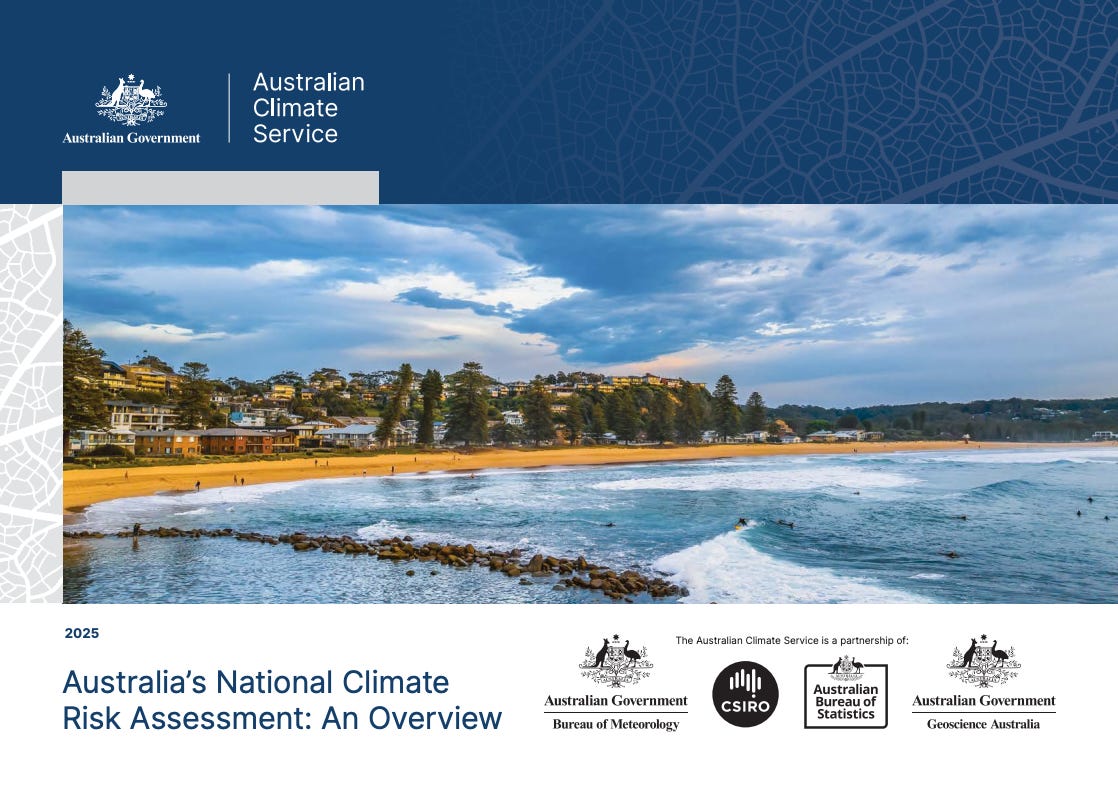
Not fun being the bearer of bad news. Especially when the bearers of bad news about climate change have faced immense ridicule and backlash for so long.
Probably not a vote winner either.
We - you and me - are also partly to blame for our low-attention behaviour online. No one clicks on climate change related stories in the mainstream channels unless it’s the day or so following a major disaster. So media outlets don’t publish them, because their ad revenue would drop.
Admittedly, there are more of those post-disaster days in recent years so it’s getting some clicks. But basically, we avoid the topic.
Media companies are businesses. They rely on clicks for their business model.
We get the media we deserve through what we choose to click on, folks.
We could also dive deep into who owns media companies and their personal agendas, but I prefer to use Hanlon’s razor: failure is more likely due to incompetence than malice.
Or, as I’ve heard it put more eloquently in Jay Martin’s Boom Town Snap novel:
If there’s a choice between cock up and conspiracy, always assume cock up.
…but I do have to point out there’s active misinformation funded by fossil fuel companies.
Misinformation is not a conspiracy theory
The Conversation published a research piece on it in October 2025. I quote from the article regarding US analysis:
“We found oil and gas lobby groups spent A$1.5 billion on public relations and advertising between 2008 and 2018.”
I’ve seen it firsthand as a consultant inside fossil fuel businesses.
Fossil fuel companies would lose good workers in droves if they didn’t shelter their employees somewhat. If that means they have to national advertising campaigns, or deny science, they’ll do it.
Which, by the way, Australian company law implies they must do or the board risks being personally sued.
‘Sorry, did you say they legally have to do it?’
Yep. Well, it’s implied anyway.
Australian company law – the Corporations Act – is an essential part of making investing viable for retail investors, such as people who want to buy shares.
If you’ve bought shares, you probably felt safe to do so because of the Corporations Act. It sets out director’s duties, and these apply to the board. It’s the group to which the executives in the C-suite, like the Chief Executive Officer, report for guidance and oversight.
The directors’ remit – their highest obligation – is the survival of the organisation.
Not the employees, not the customers, not the suppliers, and definitely not a species beyond humanity or the planet.
To quote the regulator ASIC’s website (bolding is mine):
“A company director’s main responsibility is to act in the best interests of the company and its shareholders, while ensuring the company operates legally and ethically.”
And here’s the kicker: if they fail in that duty, board members can be personally sued.
Many a non-executive director (NED) has been bankrupted by shareholders who weren’t satisfied they discharged their duties sufficiently. Trainers hammer such case studies into you during the NED training.
There are ways to minimise the liability - exculpatory provisions, indemnification and insurance.
But no career NED wants a blot foe failing to meet their directors’ duties on their record.
The shorthand interpretation for directors’ duties in Australia is ‘shareholder primacy’. Basically the needs of the shareholder are higher priority than anything else. Which sums up capitalism nicely: owners are prioritised over workers (and everything else!)
Which is why companies can make decisions that decimate the environment.
This is a feature of the law, not a bug.
Terrible choice, right? Who the heck came up with this idea!? We won’t go there, because we’re stuck with it anyway.
The implication?
A fossil fuel company saying ‘Actually, the scientists are right – we are screwing the climate. Whoops!’ would probably lose a lot of its workers, and have to pay a lot more to keep the ones who stay.
That might increase costs, it might impact production, and eventually that could flow through to share price.
The potential penalty for which is, again, being personally sued by the shareholders for not doing your job.
You’d be mad to do it.
Fortunately the laws are changing. The International Court of Justice released its Advisory Opinion on climate change on 23 July this year. They’re clear – governments (a.k.a. states - not the QLD, NSW type, the national type) can be held liable for not preventing climate change.
This is having flow-on effects already, such as overturning coal mine approvals.
There are international cases affirming the idea that a company can be held liable for its individual contribution to climate change induced (or just worsened) disasters.
But, it’s a slow lever.
The really big companies often have a ‘So sue me’ approach. Which means it’s not enough to force swift change unless the government pulls its finger out.
Which it does not appear to be doing, sadly.
(Yeah, yeah. I know. The Environmental Protection Reform Act just passed. No climate or carbon triggers, so not good enough IMO.)
Ethical investing bears some blame, too
Ethical investing has tried. Goodness knows they mean well.
But frankly, they’ve managed to turn off the majority of folks by implying moral superiority. Such stances are a kick in the teeth when you’re struggling to afford rent or a mortgage.
It’s a shame, but here we are.
If you can get past the moral posturing, the next problem lies in definitions: what is ethical?
I don’t hear anyone identify as an unethical investor. Or socially responsible, or conscious, or whatever label you want to put on it. So, it’s kind of a useless title.
There are 45 metrics on ethical investing site ethosesg.com.
Forty. Freaking. Five.
I looked up Hostplus’ Balanced again, just out of interest. Look at the scrolling for all the metrics on the side!
How the heck do you keep up with all those? It’s overwhelming.
You can find an ethical adviser – we have a co-op of them in Australia and New Zealand – but financial advice can be expensive, or at least perceived to be.
And of course greenwashing is rife. That’s destroyed trust.
Finally, you’ve got muppets who think paying a premium for an ethical investment isn’t ‘the best choice for their family’ because they don’t think it’s done well.
As if saving 0.47% on fees is going to compound up enough to compensate for having to self-insure your home and the drop to your super and shares value. Pffft.
Very short-term and expensive thinking, if you ask me.
Again, it’s rife in finance. They don’t get risk management. You can’t see me shaking my head, but I am.
And finally…
No one enjoys being the bearer of bad news
I do not find this fun.
I’m doing it anyway because the discomfort is far outweighed by the threat of what’ll happen if I don’t speak up. I know I’m doing so at personal and professional risk.
Not everyone has this luxury.
To be clear: this is also self-interested. Three degrees of warming would ruin my financial independence along with everyone else’s. I do not want that to happen.
…and, blind hope plays a role
For a long time, I had blind hope that tech would save the day.
I was sure there’d be some amazing innovation to halt climate change in its tracks. I’ve spent a lot of time in the startup and scale-up space in Australia hoping I’ll stumble across something spectacular.
Sadly, that kind of leap relies on billions of government funding for research, and guess what’s getting cut right now: research.
If we haven’t commercialised it yet, we’re not going to while the world’s billionaires are busy sending rockets into space like we’ve been doing for well over half a century, i.e. breaking no new ground.
Tech is not coming to save the day. Boo.
We still need tech, and it’s got a role in remediating the damage already done. But to my mind, it’s not Plan A anymore. Probably not even Plan B, C or D at this stage.
This is where I do have to ask you to look in the mirror, dear reader.
Do you dive deep on climate change when it pops up, or do you avoid it? No shame or shade from me if it’s the latter, I’m sure there’s some biological imperative encouraging that behaviour.
But you can’t keep it up.
This is one of those issues you’ve gotta face eventually.
The sooner, the better – a stitch in time saves nine. And if the joy of a habitable planet ain’t enough, do it because it’s going to ruin your finances if you don’t.
We have now reached the part of this Substack where we switch from problems to solutions.
First, the general solutions. Then it’s into the detail and that Move APACE stuff I keep teasing you with :) Onward…