

Why you (probably) misunderstand risk
I'm a trained risk professional thanks to my engineering career and working in major hazard facilities. Y'all are messing up when it comes to judging risk.

Interrupting my usual broadcast for a rant.
I intended to post next for a series on climate risk to homes, but I need to get this off my chest. Thanks for humouring me.
Here goes…
Assessing risk is a trained skill
…and most people don’t have it.
Some professions train you for specific types of risk assessment.
Medical triage, for example, is a specific skill set. Good luck getting that right without training. Cyber risk is likewise a specific skillset to manage. And of course, actuarial studies are the gold standard in risk calculations.
I couldn’t do any of those competently.
But risk assessment as a practice is a structured, systematic thing. It requires understanding definitions like ALARP and being about to calculate probabilities.
(If you have to look up ALARP, news flash: you ain’t there yet.)
You might have done a job safety analysis or two in your time. You might even have a professional skill set that lets you assess risk in the realm of your expertise.
But odds are strong that you are not specifically trained in risk assessment methodologies on planetary risk. This makes you are unqualified to judge them. No matter how savvy you are, no matter how accomplished you are, and no matter what your AI chat companion or favourite author tells you.
The biggest risk to you becomes believing you understand the risks when you don’t
It’s a classic case of overestimating your capability, otherwise known as the competence/confidence gap so beautifully captured by the Dunning Kruger effect.
Or, as Richard Feynman puts it:
"The first principle is that you must not fool yourself — and you are the easiest person to fool."
Why am I ranting about this?
Again and again - dozens of times in the last week alone - I hear from people who rank climate change risk as lower than war (including nuclear options), fascism and artificial intelligence (AI).
These are not the bonkers folks who think climate change is a scam. Sadly, I think those folks might be beyond help.
These people understand the climate is suffering, that our choices have caused this, and agree it’s a threat to humanity. They just think it’s lower down the priority list.
The basis for these claims varies, but it’s usually some iteration of these two underlying principles:
“I think the tech bros are a bigger threat.”
As in, social engineering, disinformation and misinformation, and the whole seedy underbelly of tech leaders creating tools perpetuating and perpetrating abuse and extraction on purpose.
I wholeheartedly agree these platforms (and the folks who build them) suck.
They are designed to make you feel awful so you’ll be susceptible to tactics like rage-baiting. They are designed reinforce echo chambers which make your most unhinged beliefs seems normalised, even rewarded. They cause untold damage in their quest for more money.
This is a feature. Not a bug.
I don’t think it’s a massive conspiracy theory. I think wealth = power, and the economic systems we humans have implemented value companies above the harm they cause. So, we cause damage while making the money that gives us power.
Again: feature. Not bug.
We - humanity - designed it this way.
None of this is inherently essential. There are no immutable laws of physics or human nature dictating things must be this way.
We made this bed. Now we’re lying in it.
We can change the sheets. We can even burn the bed if we want to.
They are reversible* choices.
*Until the singularity takes over, then all bets are off.
In that case, I refer you to this excellent post by Phil Lee, sharing a chart from the Federal Reserve Bank of Dallas (and here’s the Financial Times article link the chart comes from):
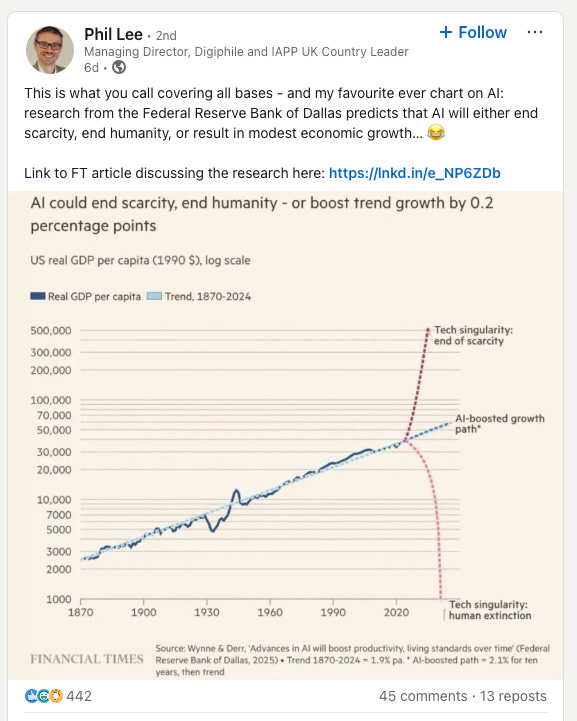
I agree Phil. Covering all bases, indeed.
“I think we’ll be able to recreate nature.”
You might be able to create some Clayton’s version of it.
But not for a very long time. It’s by no means guaranteed. And, it’s by no means desirable.
To achieve this would be at astronomic expense in terms of money spent and cost to everything we could better spend that money on, like homes, food, water, research into curing disease… almost anything is a better spend than recreating something we screwed up through avoidable choice.
If it was your child who broke their toy because they’d bashed it against a brick wall, you’d tell them you weren’t buying a replacement, right? ….right?
You’d say: you broke it, now you live with the consequences.
Saying ‘we’ll just replace nature’ is like rewarding the kid who wilfully broke his toy.
(Note: I’m not saying we should cut off our noses to spite our face and refuse to solve the problem. I’m saying the behaviour that created this problem won’t go away if you reward it this way. )
Never mind the fact that the tech required to do this needs billions (trillions?) of government funding to develop before it’s commercialised. Guess what’s been cut recently? That funding. The odds of having commercialised tech like this is getting worse, not better. And those who have it are trying to bring back woolly mammoths. For goodness’ sake.
Bluntly, this kind of thinking represents opportunity cost at its worst.
You are absolutely dreaming if you think this is a good or even feasible solution when climate catastrophe approaches in the next decade. It’s too damn late, folks. You’ve missed your window.
Pinning your hopes on this might lessen your existential dread. I’d suggest you’re better off escaping into a good novel than pretending this is possible, let alone likely. Down this path lies delusion.
And now, why do I feel qualified to write this rant?
I’m a dab hand at risk 💅
In my not-at-all-humble opinion, and I say this proudly: I know my way around risk assessment.
I’m a trained facilitator in more acronyms than I can remember, but front of mind are:
Hazard and Operability Studies (HAZOP)
Failure Modes and Effects Analysis (FMEA)
Root Cause Analysis (RCA)
Workplace Risk Assessment and Control (WRAC)
Bow tie diagrams
Process Hazard Analysis (PHA)
For a long time, my job entailed keeping people from getting hurt or dying.
I was the lead on the team to implement PHA at Kwinana Nickel Refinery in 2006/7. I got the job of sitting with the expert from Dow - considered the industry’s pinnacle of risk management - to translate the concepts into tools to assess that major hazard facility’s risk. I built those tools in good ol’ Excel, and they were still in use when I left in 2010.
In 2007, I spoke at BHP’s safety convention in Brisbane to share how we’d implemented PHA as part of our Process Safety Risk Management (PSRM) protocols, which were considered business leading.
I worked on teams and eventually led implementation of Critical Process Management at Kalgoorlie Nickel Smelter in 2008, another frontrunner in the business and presented across it.
Here are two of my professional opinions:
The finance industry does a poor job of managing risk. They either do not understand the hierarchy of control or wilfully ignore it. Both are, in my opinion, unforgivable. This goes for government agencies and industry professionals alike. If they were better at it, we wouldn’t get outcomes like First Guardian and Shield.
Most people cannot differentiate between physics and human-made risk. They mistake human choices - mostly reversible - for the immutable physical constraints that tech cannot overcome in the timeframe we’d need it to. They think they’re comparing apples and apples, when it’s actually apples and oranges. Actually, comparing apples and intergalactic aliens might a better metaphor.
…but I’m not qualified to assess planetary risk
Even with all this experience.
Even though I was 22 when first left in charge of a processing plant where I could have gone to jail for someone’s death and I tell you, that’s good motivation to manage risk.
I am not qualified to assess the planetary risk of climate change.
But I do know how to listen to the folks who are.
Scientists, specifically.
Here’s the summary, and I’m sorry to be the one breaking the bad news here. I try to avoid talking about this because I know how demoralising it can be:
Risk to humanity from climate change is catastrophic, near term (within your lifetime, but may be within two decades), and possibly irreversible. The planet’s interconnected ecosystems makes it nearly impossible to accurately model all the flow-on effects of every tipping point. If this makes you feel more optimistic, you’ve missed the point.
If we reach 3 degrees of warming - which is a decent possibility right now with the ‘drill, baby, drill’ people in charge - we’re talking mass starvation due to crop failures. Like, billions of people. Never mind the fact we’re already in global water bankruptcy in 2026. Food, water and shelter are all under massive threat.
If we have exceeded the carrying capacity of earth - and estimates range on what Earth’s carrying capacity is, with many suggesting we’ve passed it already - the amount of humans we can sustain drops exponentially.
This is the difference between physics and human decisions. You can’t tech your way out of this in the timeframe we need to.
It’s also the messy realm of possibility. We don’t know for 100% sure what will happen. This is how science works. If you’re not STEM trained, I’m sorry but chances are you won’t understand why this is important and the very basis of why science is trustworthy.
But: climate scientists are sure enough that’s it’s bad that we don’t want to find out.
Bottom line: I suggest listening to the professionals and bumping climate change to the top of your existential risks list, folks.
Thank you for this. It’s probably my favourite blog post of yours. I’m sure you know why. 😉
Sometimes I feel like I’m in a movie where the shit has already hit the fan and time has slowed down. All I can do is watch things unfold in slow motion, knowing what’s coming but unable to stop it.
It’s getting harder not to scare people. Harder not to raise my voice or want to shake people awake. Even my friends can hear the edge in my voice and try to soften it: “Surely it’s not that bad.”
So I step back. I give them a bit of hope so they can keep their vision of a future — children, stability, a good life. (That is, if they can find an emotionally mature man and housing they can actually afford.)
I remind myself often that it’s not my responsibility to wake up the world. But then the question keeps coming back: if not me, who? If not now, when?
So thank you for this. It made me feel heard — and a little less alone.
I’m by no means a dab hand at risk, nor qualified to assess planetary risk, so it looks like I'll need to listen to the professionals and bump climate change to the top of my existential risks list. Now off to investigate my investments further...