

What can you do? It's time to Move APACE
Where you put your money is your biggest lever to prevent the climate-change-induced shrinking of our collective wealth pies. Time to move it, move it!

You’re here because you’re aware climate change is threatening your wealth and therefore has the potential to make you future poor.
And you’re ready to do something about it, yeah?
Don’t panic, I’m not going to ask you to don lycra and bike everywhere, give up meat forever, or block off Sydney Harbour Bridge and risk ending up in jail.
What I’m going to suggest is far less risky, lower effort, and more impactful.
Like this:
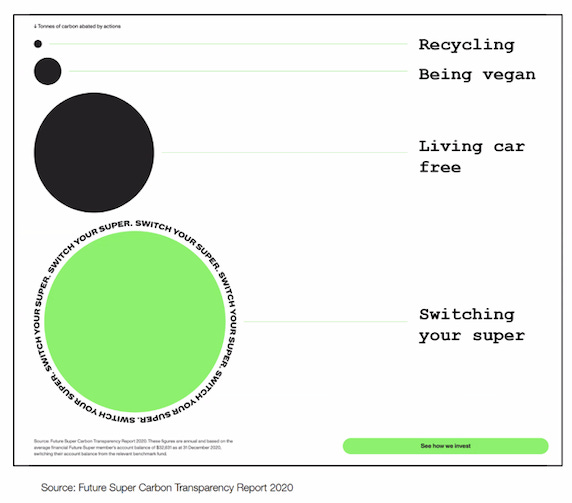
I want you to use every dollar at your disposal to vote for a future where climate change doesn’t shrink our wealth pie, by ensuring none of your money is funding fossil fuels.
Why move your money away from fossil fuels?
Burning carbon is the single biggest, avoidable lever to accelerating climate change.
Yes, there are other levers, and there are other things to do. Many things.
Nature will not rebuild itself.
But let’s start with the premise that a faster transition away from burning carbon will slow climate change, as the majority of scientists appear to agree.
You can move your money in three ways:
1. Banking
Banks around the world continue to pump trillions of dollars into the fossil fuels industry. Sources like Market Forces and Banking on Climate Chaos tell us how much per institution, if you’re curious.
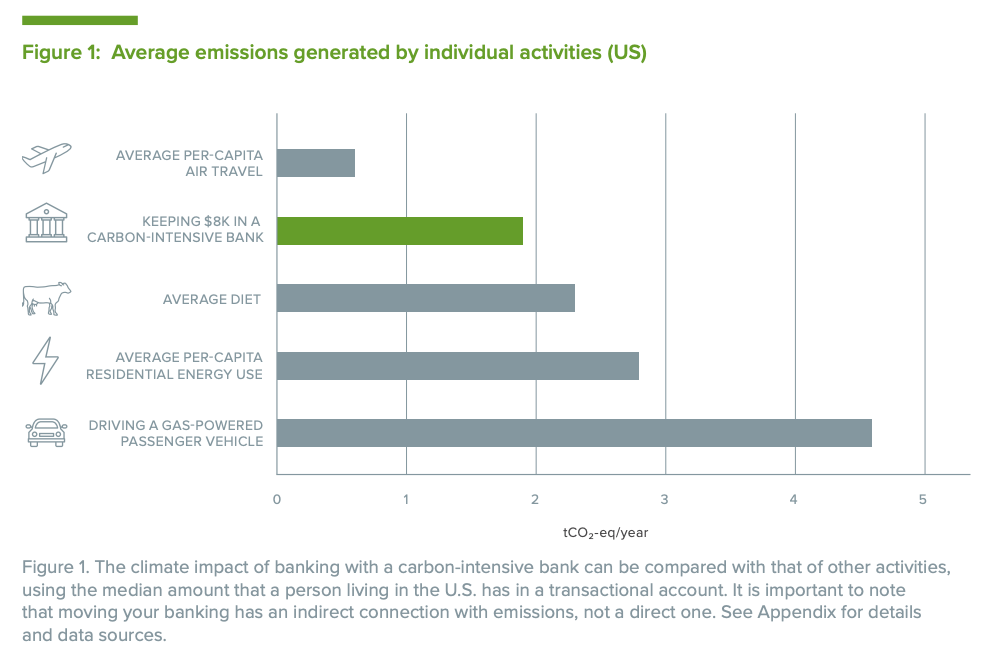
We can move our bank accounts away from institutions funding fossil fuels. Indeed, as this report in the US found, it’s one of the most impactful things we can do:
At the moment, 80% of Australians’ money sits in eight banks financing fossil fuel projects, or owned by banks who do.1
There’s a further 10 banks also funding fossil fuels or owned by banks who do, they just don’t make it into the Top 10 in terms of how much of Aussies’ money they hold.
But good news: more than 80 Australian banks aren’t funding fossil fuels.
You’re spoiled for choice!
Whether you’ve got 10 dollars or a million bucks, you can bank with an institution that doesn’t fund fossil fuels so your cash isn’t being used to erode your wealth.
Why does moving banks work?
Because anything that makes the bank less profitable has the potential to reduce share price.
Which, in turn, limits how much the bank can lend. Including to fossil fuel projects.
And we know public pressure works, so please feel free to make a song and dance about leaving. Let the bank and the general public know why you’re off.
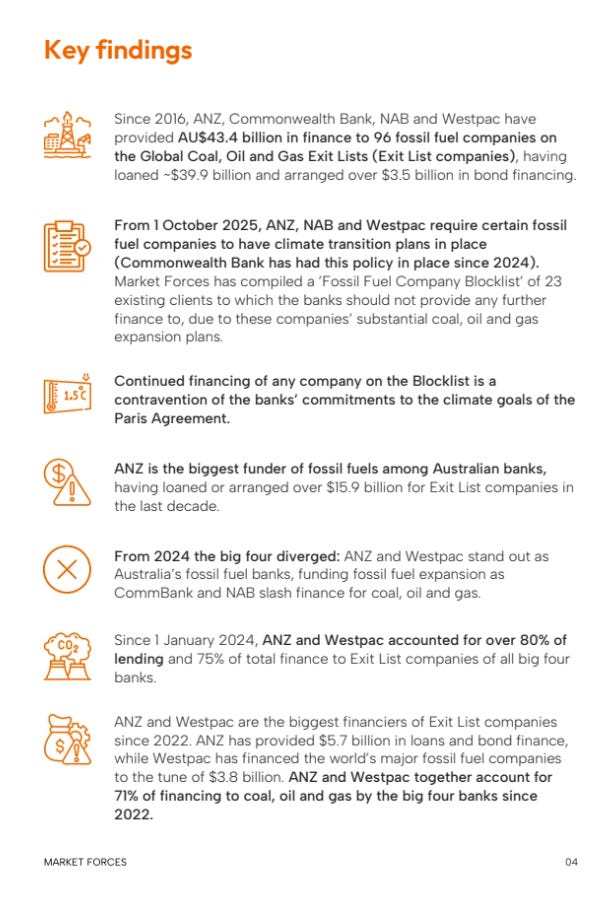
As Market Forces has recently reported, two of the big banks are changing their ways - Commonwealth and NAB - at least partially in response to public pressure. They’re not fully away from fossil fuels yet so they’re still suboptimal, but definitely not as bad as the others.
Check out Market Forces’ November 2025 Blocklist report for more details:
2. Retirement funds
We can move our super out of investment mixes that fund fossil fuels too.
Most of us end up in default ‘MySuper’ options which tend to own shares in fossil fuel producers.
Most funds offer alternatives free of this burden, which you can switch to without losing your insurance.
Or, if you’re keen to go the whole hog and get away from the banks funding fossil fuels in your super too, you can switch to a fund that doesn’t hold them either.
You just have to take steps to check you can keep your insurance before moving.
Why does moving super fund work?
Because super funds make less money when you do. They don’t get to charge you fees, they have to sell assets to allow you to move your cash… it’s basically bad news for them. Their remit is to make more money.
As with banking, tell ‘em why you’re out. The more pressure they have from their members, the more likely they are to divest in earnest.
3. Shares
You can stop buying shares with links to fossil fuels.
This could be companies that produce fossil fuels, such as coal, oil and gas.
And just like with super, you can find index funds like ETFs and LICs which don’t touch fossil fuels, and even some that don’t touch the banks funding fossil fuels.
Whether you choose to sell any holdings you already have and take the capital gains hit is up to you, but at least don’t make it worse by buying more of the same.
Why does selling (or not buying) shares work?
When you sell a share, you send a signal to the market that it’s not something you want to hold anymore.
When a lot of shares are sold, prices tend to drop.
A lower share price for a fossil fuel company reflects poorly on it. It might make getting a loan harder, for example.
And selling - or at least not buying - an index fund like an ETF or LIC is another way to signal what you want as a consumer. Again, loud and proud about it folks! Let the people deciding what underlying assets to buy hear why you’re not in.
So, you can move any and all of your banking, super and shares.
To work through this process, we’re going to…
Move APACE!
Our five steps are:
Audit - work out where your money is now, and whether any of it is supporting fossil fuels.
Plan - if you find your money is supporting fossil fuels, work out where you could move it so it doesn’t anymore.
Act - make the move, ensuring you manage risks and keep costs of a minimum (some moves cost nothing but time).
Check - make a point to look at what you’ve got once a year, just to see if anything’s changed.
Explore - work out what else you can do to stop your wealth pie shrinking.
Audit is up first, and we’ve got a tool on its way to help if you wish to use it (aiming to go live by 8 December).
Otherwise, you can do all the auditing manually yourself.
Explanations on how to do each step are up next :)
A$5.5t in residential assets total, with $4.4t in eight banks funding fossil fuels or owned by banks who do (in order of size: Commonwealth Bank, Westpac, NAB, ANZ, Macquarie, ING, Suncorp, HSBC. Compared savings.com.au data against Market Forces’ Compare banks table. Ten more banks also funding fossil fuels or owned by banks who do: Bank of China, Rabobank, abal banking, Bankwest, Citi, UBank, Bank of Melbourne, BankSA, RAMS and St George
Thanks for all this info.