

First things first: where's your money at?
Your first APACE move is Audit - working out whether your banking, retirement fund and/or shares are currently 'in' fossil fuels. Brace yourself for a shock.

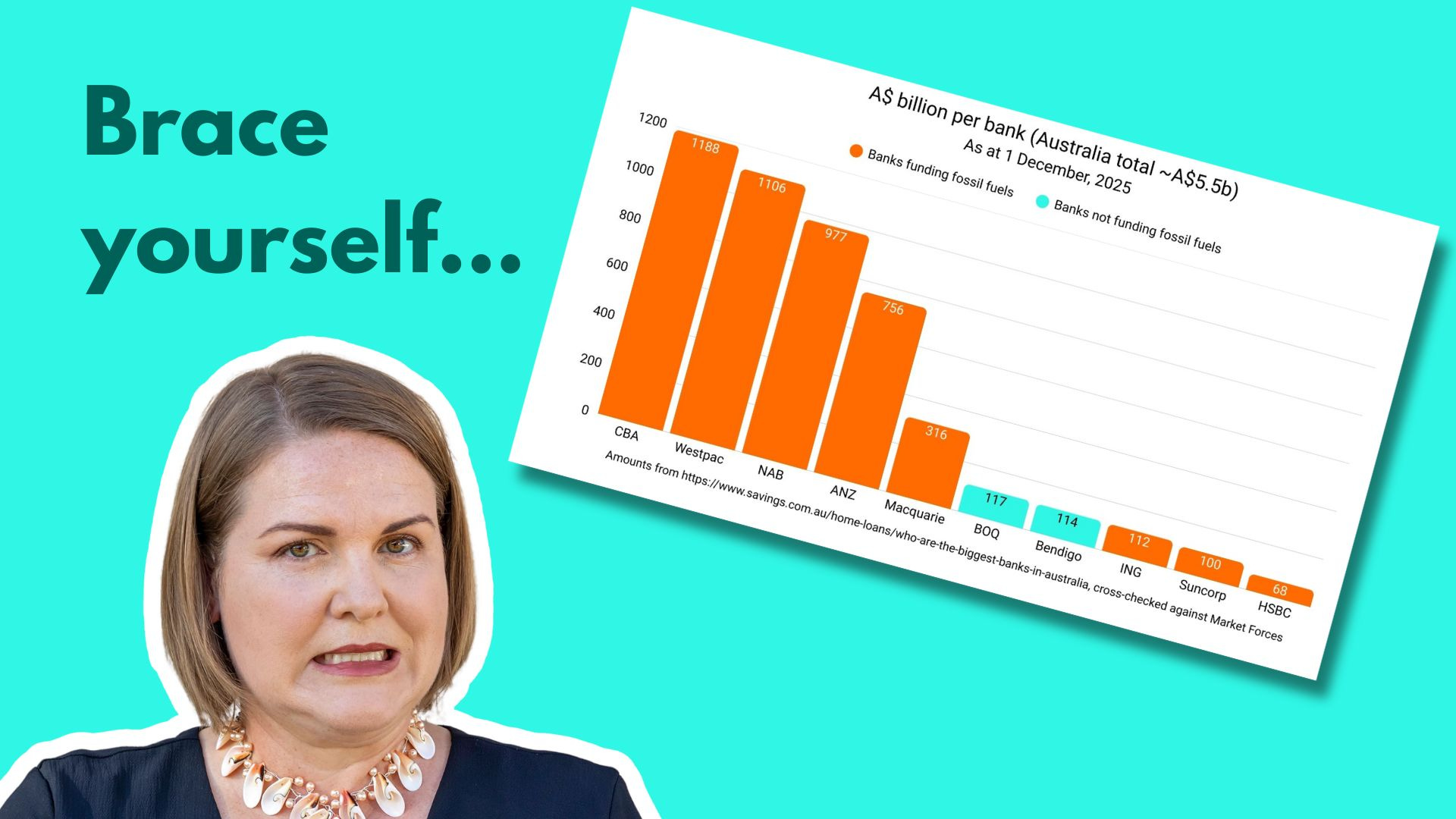
In late May 2025, when I was digesting all the things I’ve listed on the previous blogs, I thought I’d better take a look at where my money was.
Dear reader, I was SHOCKED. Shocked, I tell you.
Apart from one bank account and a few ETFs, every single thing I had supported fossil fuels.
Every. Single. Financial. Asset.
I kid you not, I had:
20 (!) bank accounts in one bank that funds fossil fuels.
My only superannuation account in a fund that held shares in fossil fuel companies.
Three index funds which held shares in fossil fuel companies.
So when I say brace yourself, this is what I mean. You could be in for a nasty shock.
But, you have to know before you can change, right?
That is your task in this first step: to Audit your accounts.
Side note: This post lays how to audit your accounts yourself. My small but mighty team is developing a tool to help Aussies do this through a simple check-box survey. I’ll add the link in here when it’s ready.
It’s time to work out where your money is
…and if it’s in a bunch of undesirable spots like my money was, the excellent news is: changing is simple.
Of course, you might discover you’re already well clear of fossil fuels in your finances, in which case happy days! You can jump to the ‘Check’ posts.
If you’re not 100% sure, and I do mean 100% – like, you’ve looked recently and you would bet 100 bucks on it – an Audit is a must.
You’re gonna audit three things: banking, super and shares.
Now, before you wade into this, I want to make two things clear:
1. You are not interested in sustainability statements
…or annual reports claiming credible transition plans, mentions of the Paris Agreement, or any other text.
You are interested in one thing: the numbers.
We look only at credible sources, preferably from the funds themselves. No ratings agencies, no ethical investing scores. Just the holdings or $ lending to fossil fuel companies.
Too much can be hidden in the text and we don’t need it, so chuck that in the bin.
2. You are not interested in relative totals either
This is a simple yes/no situation. You don’t need to know % exposures.
Does the bank, retirement fund or shares you hold connect to fossil fuels? Then your money’s helping fossil fuels. Simple as that.
Capiche? Off we go…
Step 1: Audit your banking
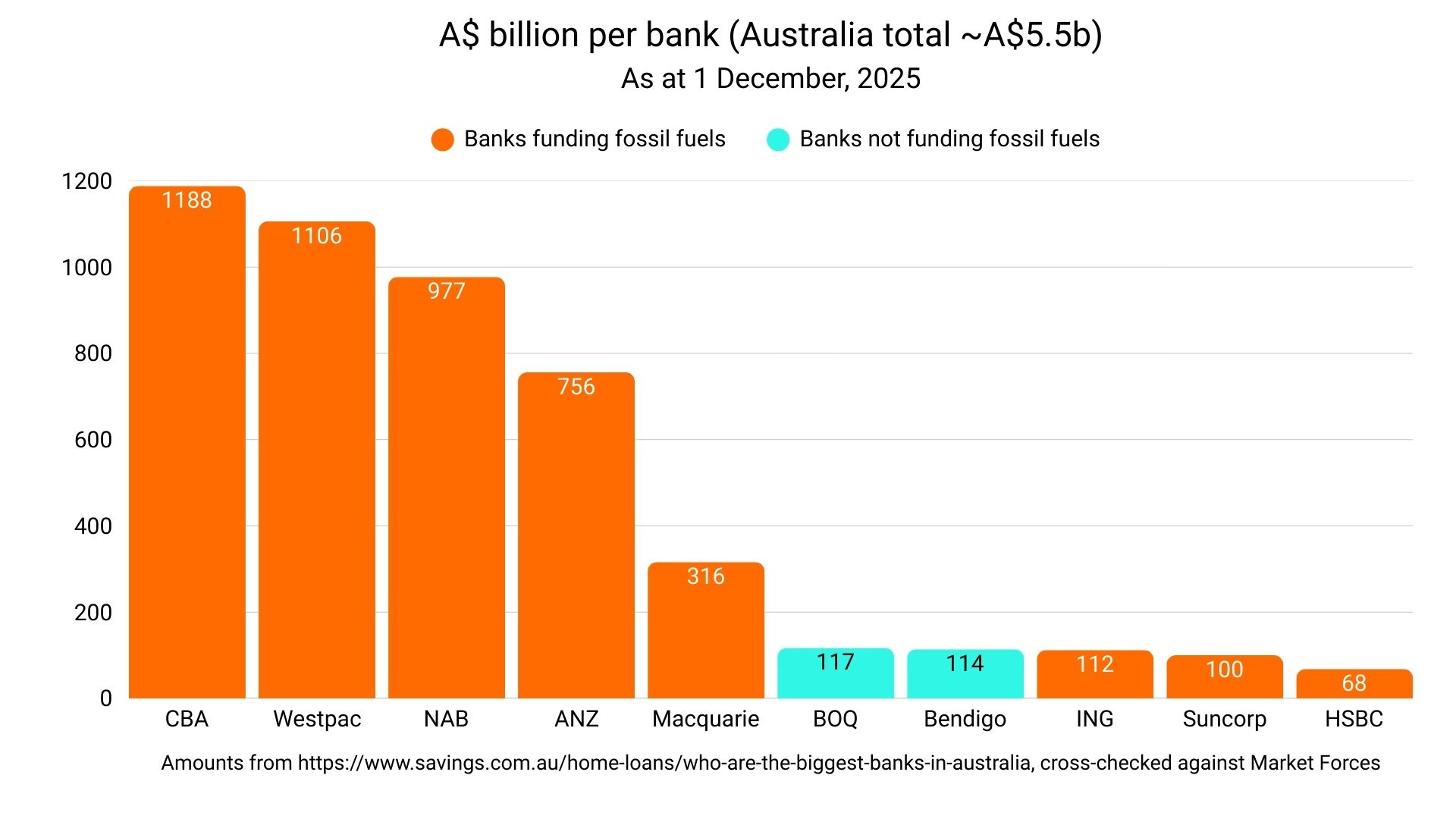
More than four in every five Australian banking dollars (aka ‘residents’ assets) are in eight banks which fund fossil fuels or are owned by banks who do.
That’s A$4.6 trillion making lending to fossil fuel projects possible.
And I’m not counting the little bits and bobs in the 10 other banks funding fossil fuels or owned by banks that are.
(At the time of writing, and for completeness, joining the eight orange-bar banks in the chart above in funding fossil fuels or owned by those that are: Bank of China, Rabobank, abal banking, Bankwest, Citi, UBank, Bank of Melbourne, BankSA, RAMS and St George).
It comes to 84% of our money, so there’s a roughly 84% chance you’ll find you have your money in a bank that fund fossil fuels.
Great news: there are two organisations who’ve trawled through all the numbers to find out whether your bank is funding fossil fuels, and how much money is involved.
» Our preferred (Aussie) source: Market Forces
We use their bank comparison table to determine which banks fund fossil fuels. It is *chef’s kiss*.
The data in it is from 2016 to 2023. You can read their methodology on their website.
Their assessment worked out which banks:
Fund fossil fuels, or are owned by banks that do (boo)
Don’t fund fossil fuels and have a clear statement to that effect (yay)
Don’t fund fossil fuels but have not made a clear statement (so-so, or six-seven if you’re my kids)
Their table has not been updated since 2023. At the time of publication (1 December 2025) it includes the following statements:
Note: While we strive to be as comprehensive as possible, our data may not capture every single instance of a bank’s fossil fuel lending, particularly for smaller amounts. See our methodology for more detail.
Disclaimer: This information is not intended to provide financial product advice. You should obtain independent advice before making any financial decisions. Market Forces does not receive any remuneration or other benefits in relation to the information conveyed.
In November 2025, Market Forces published a Blocklist Report which updates the status of fossil fuel lending for the Big 4 Banks (ANZ, Commonwealth, NAB and Westpac).
Their research showed all four continue to fund fossil fuel projects, but both Commonwealth and NAB are doing much less of it in recent years and are signalling an intent to stop the practice entirely. ANZ and Westpac remain large funders of fossil fuels in Australia, and have not signalled a meaningful intent to change.
Still, we’re taking an absolute stance here. They either finance fossil fuels or they don’t. Keepin’ it simple.
» International source: Banking on Climate Chaos (BOCC)
There’s an international site called bankingonclimatechaos.org, which covers the big banks worldwide. Australia’s Top 4 get a guernsey on there. At the time of publication, they include 2024 data in their tables.
The trick is to look at all your banks, as you might have more than one.
All the savings and transaction accounts, mortgages, overdrafts, business accounts etc – it’s all fair game.
The great news is, there’s over 80 alternatives in Australia!
They’re all licensed banks and with competitive deals, and not funding fossil fuels. I promise you will be spoiled for choice if you decide to move.
But we’re getting ahead of ourselves…
If you found an account is with a bank that funds fossil fuels, make a note of the account type. You’re going to need it in the Plan step.
Now it’s time to…
Step 2: Audit your retirement fund
There was A$4.129 trillion in assets in the superannuation industry.
$2.891 trillion of that was in APRA-regulated funds.
…but how do you know what your super is invested in?
Market Forces has a super comparison page, but I personally like to go to the source itself since they’ve calculated a % exposure instead of an absolute decision.
Look, Market Forces’ approach is probably more robust. But this one’s cleaner.
Again, great news: you don’t have decipher anything in an annual report. You can just look at what the super fund holds – its investments – to see if it’s supporting fossil fuels.
They have to disclose their holdings publicly, so they’ll be on your super fund’s site. And if that sounds like too much work, our handy audit tool will do it for you; I’ll add the link when it’s live.
But if you’d like to do it yourself, you can like this:
» Find your fund and investment mix
First, you’ll need to work out what you’re invested in. Chances are high you’re in the default MySuper option, and most commonly with an industry fund, but check if you’re not sure.
Log into your super account, or check via the ATO site (log in using myGov), or if you’re getting paper statements, pull out the last one.
You’re looking for:
the name of the fund, e.g. UniSuper, Hostplus, MLC
the name of the investment mix you’re in. This often has a name like ‘Balanced’ or ‘High Growth’ – or ‘Balanced High Growth’! They love their branding.
» Find that investment mix’s holdings
Now, pull up your preferred search engine and type in ‘[Super fund name] [investment mix name] holdings’.
Here’s an example using Barefoot’s recommended fund Hostplus, but I’ll use a different investment mix from the one he recommends. You can search your fund’s site directly, but I find a generic search usually gets me there just as quick.
Type in the name of the fund, the investment mix and add ‘holdings’:

I had to scroll to the bottom of the page that came up, but hit the jackpot - holdings link!
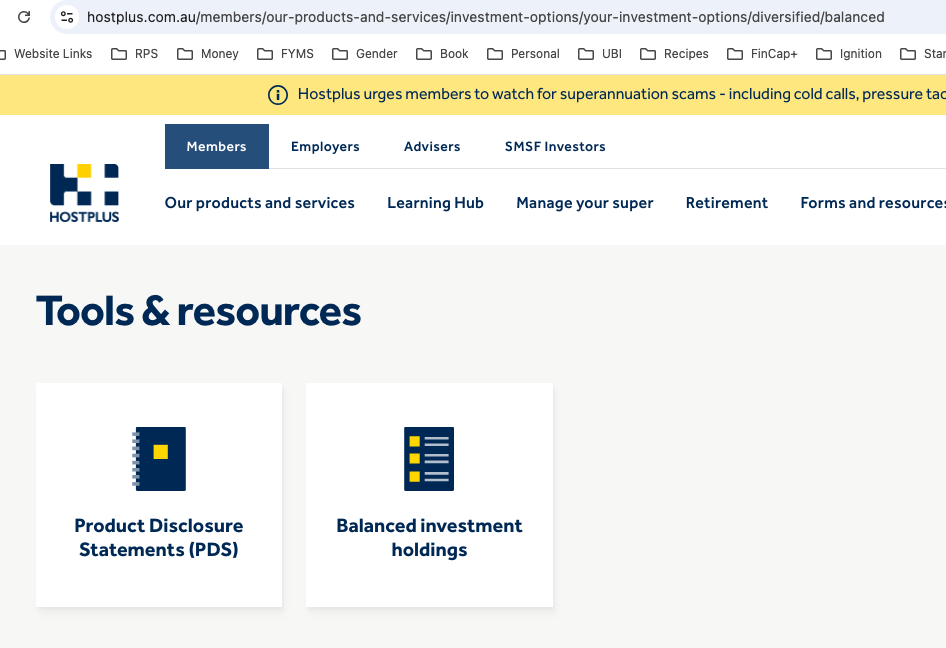
Some funds will have the holdings list on a page specific to that investment only. Others will do what Hostplus has done and put them all on the same page (see below). Some will have a table embedded, some it’ll be a downloadable spreadsheet.
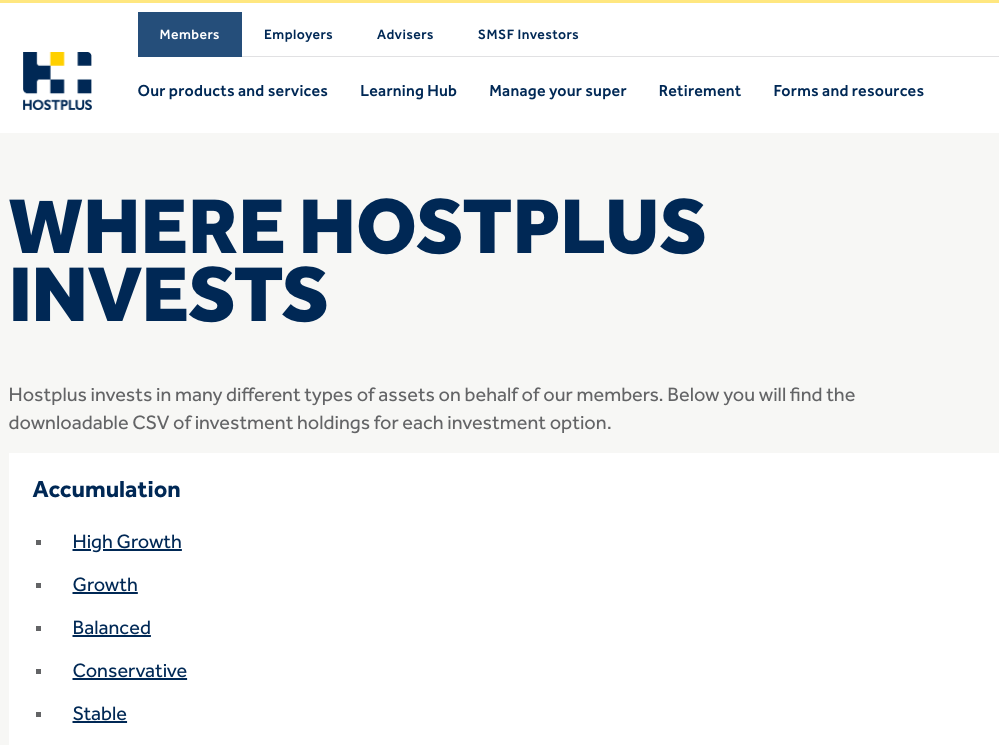
I selected ‘Balanced’ which is the default MySuper option (most folks end up in these defaults) and the download started:
» Check the holdings for fossil fuel companies
Now, you want to check if it’s got fossil fuel companies in there.
According to Market Forces, there are 190 climate wrecking companies to look out for. But if you’re looking at an investment holding Australian shares like most MySuper products do, here’s a shortlist to start with:
Woodside Energy Group (WDS),
Santos Ltd (STO),
Yancoal Australia Ltd (YAL),
Whitehaven Coal Limited (WHC),
New Hope Corporation Limited (NHC),
Ampol Limited (ALD).
If your super fund holds any of these, your money is helping fund fossil fuels.
For example, continuing the Hostplus example from above:
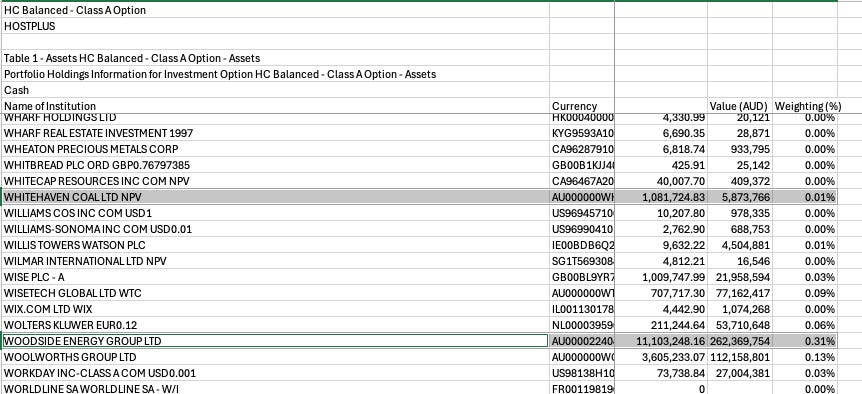
The downloaded .csv lists everything. I can see they hold coal miner Whitehaven Coal and oil & gas behemoth Woodside:
» Optional: Check the holdings for banks funding fossil fuels
Now, for the extra-special overachievers:
You might also want to get away from having your super helping those banks funding fossil fuels.
Again in Australia, if they’re holding any of the Big 4 – especially Westpac and ANZ – they’re helping fund fossil fuels.
Great news: most super funds offer an investment mix without fossil fuels, which is easy to move to (it’ll take you less than a minute once you’re logged in).
If you’re with an industry fund, it’s harder to find one without the fossil fuel funding banks, so you might have to switch funds – not just investment mix - if that’s what you’re after.
But that’s up next in Plan. We’ve gotta finish what we started, so it’s time to…
Step 3: Audit your shares
Shares! Feels like everyone’s favourite investment since COVID, especially since property prices went nuts.
If you don’t own shares and don’t intend to, you can jump to the next post.
If you own shares or plan to buy some, let’s make sure they’re not funding fossil fuels.
Broadly speaking, you can:
own direct shares – as in, you own a specific company - or
own an index fund, or basket of shares. For example in Australia, we have exchange traded funds (ETFs), listed investment companies (LICs), and real estate investment trusts (REITs).
» Check direct company shares
If you own direct company shares, it’s pretty straightforward: do they produce fossil fuels? For example, do you own:
Woodside Energy Group (WDS),
Santos Ltd (STO),
Yancoal Australia Ltd (YAL),
Whitehaven Coal Limited (WHC),
New Hope Corporation Limited (NHC),
Ampol Limited (ALD).
» Find index fund’s holdings
If you own an index fund, again, great news: you don’t have decipher anything in an annual report. You can just look at what the index fund holds – its investments – to see if it’s supporting fossil fuels.
They have to disclose them publicly, so they’ll be on their website.
And if that sounds like too much work, our handy audit tool will be able do it for you - I’ll add the link when it’s live.
But if you’d like to do it yourself, you can like this…
Pull up your preferred search engine and type in ‘[name or ticker code of index fund] holdings’. This should take you to a link on their website where you can find the listing. It might be a table embedded in the site, or a downloadable spreadsheet.
I’ll use another Barefoot recommendation, Australian Foundation Investment Company (AFIC.ASX). Here’s the search I used:

…which took me to this page, which only shows the Top 25 holdings but it’ll do for a first pass. We’re only looking for a yes/no remember, so if we find anything that qualifies as a fossil fuel producer, we’ve got our answer:
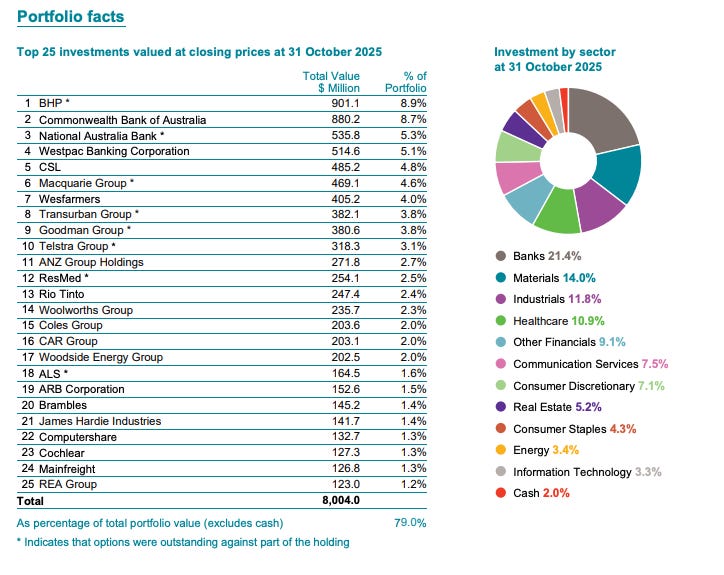
There was a table as I scrolled down, but I liked this summary in the downloadable PDF:
» Check the holdings for fossil fuel companies (and optional: fossil fuel funding banks)
Now, you do exactly the same process as you did for your super (scroll back up if you need a refresher).
If your index fund holds fossil fuel producers or the banks that fund them, your money is helping fund fossil fuels.
So, I can see from AFIC’s snapshot they’re in Woodside. Case closed.
If that wasn’t enough, I can also see they’re in five banks which fund fossil fuels. Bummer.
And the bad news is, most index funds that track the market broadly in Australia are like that. Banks qualify as ‘ethical’ in a lot of index fund screening, so it’s rife.
Make a note of any index funds or direct company shares you’re holding which fund fossil fuels, alongside any banking or retirement funds you’ve got.
You’ll need them for the next step, which is Plan… see you there!